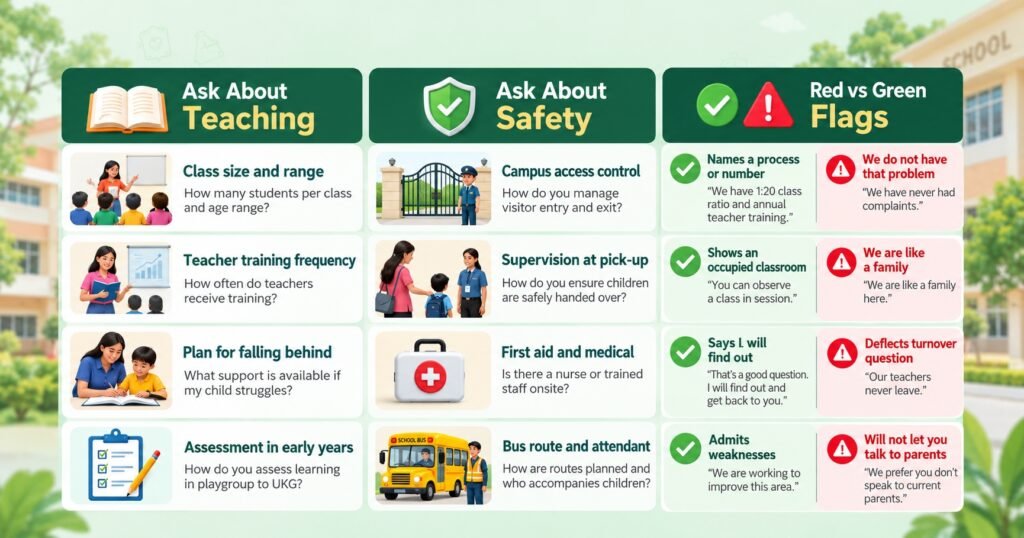
A school tour is the only part of choosing a school where you get to see how it actually runs. Brochures show facilities that exist. A tour shows whether teachers are engaged, whether children look settled, and whether the answers you get are specific or rehearsed. Most parents spend 45 minutes on a tour and ask four questions. This checklist covers what to ask, what the answers should sound like, and which ones should make you pause.
Key Takeaways
- → Go during a working day and ask to see a classroom in session. Every school has a showcase room, and the ordinary classroom tells you more.
- → Look for specific answers. A named process, a number, or a person is a real answer. “We take care of every child” is not.
- → Red flags sound like reassurance, not information. Deflecting a question about class size or teacher turnover is itself an answer.
- → Book tours early in the 2027-28 season. Popular Nandyal schools fill sections while families are still comparing options.
Why Does the Tour Matter More Than the Brochure?
The tour matters more than the brochure because it is the only unscripted view you get. Marketing materials are produced months in advance and show the school at its best. A tour shows a normal Tuesday.
Look at the children first, not the buildings. Are they absorbed in what they are doing? Do they approach a teacher without hesitation? Children in a well-run school look occupied rather than managed.
Then look at the teachers. A teacher who stops to acknowledge a child during a tour, without being prompted, is doing what the school’s philosophy claims. A teacher who continues reading from a script while children wait is showing you the daily reality.
Notice how corridors feel. Noise is normal in a school that is working. Silence is worth questioning, because it often means children are being kept quiet rather than engaged.
Ask to see a classroom in session, not empty. Every school has a showcase room. The ordinary classroom tells you more than the model one.
Finally, note whether the tour guide can answer questions or defers everything. A tour that is a recited script tells you the school manages parents rather than explains itself.
What Should You Ask About Teaching and Learning?
Teaching questions get you past facilities and into daily practice. Ask these early, while you are still in the classroom.
How many children are in a typical class? Follow up on the range, not the average. A school reporting 30 with sections sometimes at 45 is telling you something different from one reporting a consistent 28.
How are teachers trained, and how often? Continuous professional development is the strongest single predictor of classroom quality, and international evidence on school quality consistently ranks teacher effectiveness above facilities (OECD, 2024). Ask when the last training happened and what it covered.
How do you handle a child who is falling behind? Listen for a named process rather than reassurance. Remedial classes, diagnostic assessment, and parent contact are specific. “We take care of every child” is not an answer.
What does assessment look like in early years? For pre-primary, look for observation-based assessment rather than formal testing. The National Education Policy 2020 places ages 3 to 8 in one Foundational Stage built on play-based learning (Ministry of Education, GoI), and a school that tests this age group formally is out of step with it.
How is the curriculum sequenced across years? A school should be able to explain what a child gains each year, not just what subjects are taught. Vague answers suggest the curriculum is a set of textbook chapters rather than a progression.
What happens in a typical day for my child’s age group? Ask for a timetable. A schedule that includes free play, outdoor time and rest alongside instruction is a good sign for younger children.
What Does Safety and Wellbeing Look Like Day to Day?
Safety questions are where vague answers are most common, so ask for specifics rather than assurances.
How is the campus access controlled? Look for single-point entry, visitor logging and a gate that is staffed during drop-off and pick-up. Ask what happens if an unauthorised person arrives.
Where is the child while waiting for pick-up? This matters most before Class 1. A school should be able to describe supervision between the last bell and collection.
How are medical needs handled? Ask who is trained in first aid, whether a medical professional is present, and how the school communicates with parents during an incident.
What is the route and supervision on the school bus? If transport is a factor, check the route, the pickup windows, whether there is an attendant on board, and how late-running buses are communicated.
How does the school handle bullying? Listen for a defined reporting path and a record-keeping process. Guidance on school safety recommends documented anti-bullying procedures with a named staff member responsible (UNESCO, 2024). A school that says bullying does not happen is either not tracking it or not being straight with you.
How do you communicate with parents? A named channel with a stated frequency is better than “we keep parents informed”. Ask how quickly you would hear about a problem, not just a result.
What Do Red Flags and Green Flags Sound Like?
The clearest differences show up in how answers are delivered rather than what is said. Compare the two columns.
Green flags start with specifics. The person answering names a process, a person, or a number. When they do not know, they say so and offer to find out. They take you into an occupied classroom without hesitation. They discuss challenges the school has faced and what changed as a result.
Red flags start with reassurance. Answers like “we do not have that problem” or “we are like a family here” are not information. Deflecting a question about teacher turnover or class size is itself an answer. A tour that avoids showing a lesson in progress is worth questioning.
A red flag worth taking seriously is a school that will not let you speak to a parent independently. Schools with nothing to hide do not control who you talk to.
A green flag worth weighing heavily is consistency. If the principal, the teacher and the admissions staff all describe the same approach to discipline or assessment, the school has a coherent culture rather than a good sales pitch.
One more: ask the same question twice to different people. A large gap between the answers tells you communication inside the school is weak.
What Should You Ask Before You Leave?
The closing questions determine whether the school is a real option. Ask them after you have seen the teaching, because they are about logistics rather than quality.
What are the key admission dates for 2027-28? Get the dates in writing. Shortlisting elsewhere and discovering a closed window is the most common avoidable mistake parents make.
What documents are required? Birth certificate, transfer certificate, previous school reports and address proof are typical. Ask whether anything needs attestation and how long that takes.
What are the assessment or interaction requirements? Some schools hold a readiness interaction for pre-primary rather than a test. Find out what it involves so your child is not surprised.
Is there a waiting list, and how is it ordered? For popular schools in Nandyal, ask directly. A clear answer tells you whether you need a backup option.
Who is my point of contact after today? Get a name and a channel. Admissions offices become hard to reach in peak season, so having one person helps.
What are the next steps after we submit? A school that can describe its process clearly is a school that runs its admissions well.
How Do You Decide Between Two Good Schools?
Decide on the details that match your child, not the ones that look best on a comparison sheet. Two schools can both be well run and still suit different children.
Weight teacher warmth first. For younger children especially, the relationship with the class teacher shapes the year more than facilities do. If your child would struggle with a large or fast-paced group, ask whether smaller sections exist.
Then weigh the practical load. A 40-minute commute each way adds over six hours a week. That cost falls mostly on the child, and it accumulates across a term.
Consider continuity. A school that runs classes through the full school-leaving stage avoids a second admission process later. Ask whether the school plans to add grades and how confident that plan is.
Finally, weigh the answers you disliked. Every school has weaknesses. The question is whether the ones you heard are ones you can live with for several years. A school that admits its weak points and describes how it handles them is usually a better bet than one that claims none.
Plan the Tour Before the Season Starts
Tour season for 2027-28 begins earlier than most parents expect, and the strongest schools fill sections while families are still comparing options. Booking a tour in the first half of the season gives you a real choice rather than a waiting list.
Three things make a tour useful. Go during a working day so you see normal lessons. Ask the same questions at every school so your comparison is fair. Write down the answers before you leave the parking lot, because the details blur between visits.
Take your child if the school allows it. How a child responds to a classroom, a teacher and the noise of a real school day tells you something no checklist can.
If you want to see how IDPS Nandyal runs its classrooms, book a visit through our school admission enquiry, review our academic programmes for the 2027-28 cycle, or read our guide to school safety checks every parent should make. We welcome parent visits during school hours.