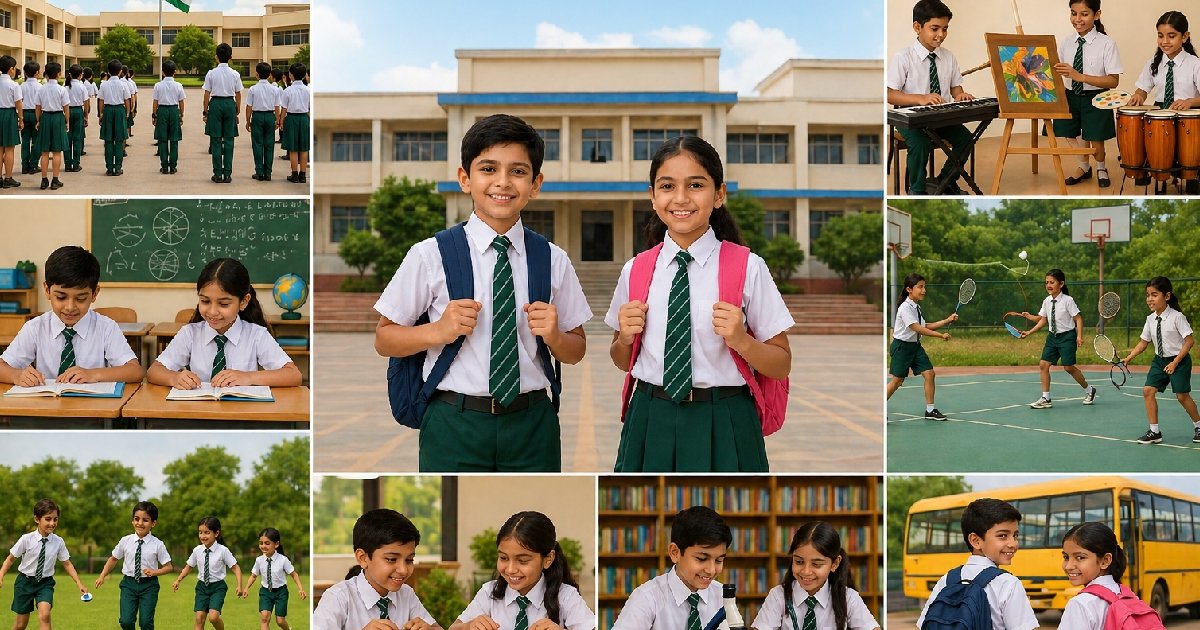
Routine. That’s the word most students use when they describe school. Wake up, go to class, come home, repeat. But at IDPS Nandyal, every day looks different depending on which grade you’re in. The Montessori kid’s morning isn’t the same as the Class 10 student’s. And that’s intentional.
If you’re a parent considering IDPS Nandyal for your child, here’s what a typical day actually looks like — broken down by wing.
- How a Montessori morning differs from a high school day
- What happens during the school’s peak activity hours
- How after-school activities are scheduled and run
- The real-world skills students walk away with each day
6:45 AM — The Day Starts Before the Bell
Students begin arriving on campus from 6:30 AM. The 5-acre grounds are already active — some kids use the morning time to practice cricket shots on the back field before class. Others head to the library, which opens early for quiet study.
The early start isn’t accidental. According to the National Sleep Foundation, adolescents who start school later in the morning perform better academically. IDPS Nandyal follows a schedule that reflects this — classes begin at 8:00 AM, giving students time to settle in rather than rushing through breakfast.
8:00 AM — Assembly and the First Period
The day opens with a short assembly. Depending on the day, this includes the national anthem, a thought for the day, and either a brief news update or a student presentation. The assembly runs for 15 minutes and it’s where the school culture shows up most visibly — students take turns leading it, not just teachers.
After assembly, the first period begins. In the Montessori and Primary wing, the first hour is usually language or numeracy, taught through activity-based learning rather than lecturing. In the Middle and High School, it’s typically the most challenging subject of the day — mathematics or sciences — when the mind is freshest.
8:00 AM – 12:30 PM — The Academic Block
The morning block runs four periods of 50 minutes each, with a short break between the second and third period. Here’s how the sections break down:
- Montessori (Nursery–UKG): Activity stations rotate every 30-40 minutes. A child might spend one cycle on pre-reading activities, the next on sensory motor skills, then circle time, then free play. The environment is prepared — shelves are organized, materials are accessible, and children move at their own pace. See the full academic programs offered at IDPS Nandyal. Teachers observe and guide, rather than direct.
- Primary (Grades I–V): Structured lessons in language, mathematics, environmental studies (EVS), and computer education. STEM activities are woven in — a Grade 3 lesson on the water cycle might include an actual experiment with evaporation. Homework is assigned but it’s minimal and purposeful.
- Middle School (Grades VI–VIII): Full subject specialization begins. Students move between teachers for physics, chemistry, biology, mathematics, social science, and languages. Lab work starts in Grades 6–8, giving students hands-on experience before the board exams.
- High School (Grades IX–XII): The academic intensity picks up significantly. Board preparation for Classes 10 and 12 runs alongside regular classes. PCM (Physics, Chemistry, Mathematics) and PCB (Physics, Chemistry, Biology) streams are offered, plus commerce and humanities. Students in Classes 11 and 12 get dedicated counseling sessions for JEE, NEET, and CUET preparation. Learn more about admission requirements for Classes 9-12.
12:30 PM – 1:30 PM — Lunch and Recess
Recess at IDPS Nandyal isn’t just a break — it’s deliberately structured. The 30-minute lunch window is followed by a 30-minute recreation period. Students eat in their designated zones (each grade has its own area on the campus), then head outside.
What’s worth noting: there’s no restriction on movement. Primary kids can use the playground, middle schoolers often play organized cricket or basketball, and older students sometimes use the time for quiet reading or chatting with teachers. The campus layout keeps different age groups in separate zones so every age gets appropriate space.
1:30 PM – 3:30 PM — The Afternoon Block and Electives
After lunch, the afternoon schedule shifts. In the morning block, the focus is on core academics. In the afternoon, students engage with subjects that build different kinds of capability.
Montessori & Primary — Art, Music, and Physical Activity
Afternoons for younger students include dedicated periods for:
- Physical Education — Organized games that teach teamwork, not just fitness
- Music and Dance — Both classical and contemporary forms, taught by specialist instructors
- Art and Craft — Fine motor skill development through drawing, painting, and construction
- Library time — At least one period per week in the school’s resource library
Middle & High School — Labs, Sports, and Innovation
For older students, the afternoon block includes:
- Science Laboratories — Physics, Chemistry, Biology, and Computer labs are all accessible during dedicated lab periods. Students don’t just read about experiments — they perform them.
- Sports Training — The school has professional-grade facilities for cricket, basketball, volleyball, athletics, and indoor games. Explore the complete facilities at IDPS Nandyal. Students who compete at district and state levels train here daily after class hours.
- Innovation and STEM Labs — Robotics, coding, and hands-on scientific research. The school has 10+ specialized labs for these areas. Students working on STEM projects have access to equipment that typically only urban schools in larger cities provide.
- Language Lab — English communication skills get dedicated focus. With a 15:1 student-teacher ratio, each student gets regular speaking practice.
3:30 PM – 4:30 PM — After-School Activities (Clubs and Sports)
This is where IDPS Nandyal differs from most schools in Nandyal. After regular classes, the school runs a structured activities program — not optional add-ons, but part of the weekly schedule.
- Sports squads — Cricket, basketball, athletics, and volleyball teams practice daily with trained coaches. Several students have represented the school at district-level competitions.
- Music and Performing Arts — Classical music, western music, dance (classical and contemporary), and theater. The school conducts an annual cultural event where all students participate — not just the “talented” ones.
- STEM and Coding Clubs — Students work on robotics projects, participate in coding competitions, and run science exhibitions. The school’s participation in external competitions is increasing year over year.
- Art Club — From sketching to digital design, students explore different art forms with a dedicated art teacher.
According to UNESCO’s Global Education Monitoring Report, students who participate in structured extracurricular activities show 15% higher academic engagement than those who don’t. The school has designed its after-school hours specifically to capture this benefit.
What Students Actually Take Away Each Day
It’s one thing to list the schedule. What matters more is what students develop over time.
A Montessori child who spends three years in the program typically develops stronger fine motor skills, better social confidence, and more intrinsic motivation to learn than peers in traditional preschool settings. These aren’t soft claims — they’re observable outcomes documented in Montessori research globally.
A Class 8 student who’s been through the STEM labs isn’t just learning concepts. They’re learning to solve problems, work in teams, and handle failure productively. The robotics club at IDPS Nandyal has students who previously had no coding background but can now build and program autonomous vehicles by Grade 8.
For high school students, the combination of board exam preparation and competitive exam counseling means they’re not left to figure out their next step alone. The school provides structured guidance for JEE, NEET, and CUET alongside CBSE academics.
A Typical Week — Structured Variety
Each day isn’t identical. The school follows a weekly rotation that ensures students get exposure to all activity areas throughout the week:
- Monday: Regular academics + Sports training + Language lab
- Tuesday: Regular academics + Music + STEM club
- Wednesday: Regular academics + Art + Sports training
- Thursday: Regular academics + Dance + Coding club
- Friday: Regular academics + Physical education + Assembly presentations
- Saturday: Half-day — academics in the morning, community service or special activities in the afternoon (once per month)
How IDPS Nandyal Compares to a Typical Nandyal School Day
If you’ve looked at other schools in Nandyal, you’ve probably noticed the pattern: long school hours (often until 4 PM), heavy homework loads, and few structured extracurricular options. The typical government or private school in Nandyal packs academics into 6-7 hours with minimal break for anything else.
IDPS Nandyal runs a tighter schedule — the day ends by 4:30 PM including activities — but the time is used differently. There are no long hours of idle sitting. Every period has a purpose, every break is structured, and every student participates in something beyond textbooks.
The result: students don’t come home exhausted from a 6-hour academic grind. They come home having had a full day — physical, creative, and intellectual.
The Bottom Line
A day at IDPS Nandyal is designed with intentionality. The schedule isn’t the default Indian school pattern — it’s a carefully structured progression that balances academic rigor with creative development, physical activity, and life skills.
Whether your child is in Montessori or high school, the school day is built to ensure they grow in multiple directions simultaneously — not just academically.
If you want to see this in person, schedule a campus visit. The best way to understand the difference is to watch a day unfold — not read about it.
Contact IDPS Nandyal to schedule a campus tour:
📍 Ayyalur Metta, Nandyal (D), Andhra Pradesh
📞 +91 9912041777 / +91 9912042777
📧 info@idpsnandyal.com
This guide is based on the typical weekly schedule at IDPS Nandyal. Specific activity slots and timings may vary by grade level and academic calendar.