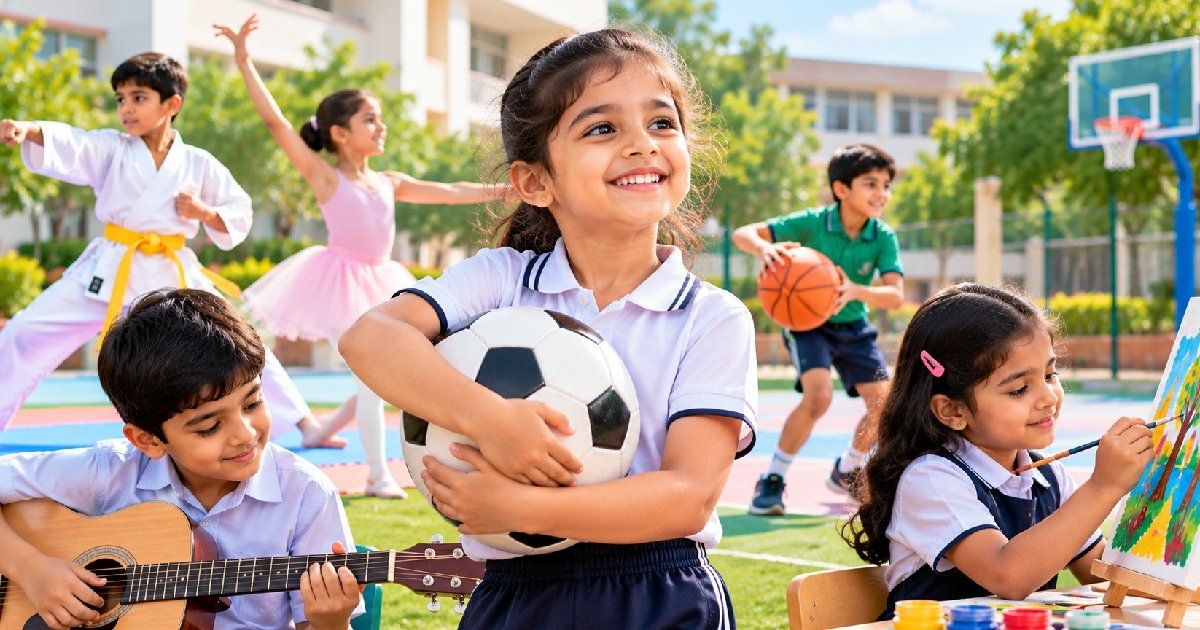
Most children in Nandyal spend the school day sitting still, then go home to a screen. That pattern has a cost: 81 percent of adolescents aged 11 to 17 worldwide don’t get the 60 minutes of daily activity the World Health Organization recommends (WHO, 2020). Extracurricular activities and sports are the cheapest correction a family can make, and they build more than fitness. Here’s what the research shows, and how to choose activities without overloading the week.
Key Takeaways
- → Children aged 5 to 17 need 60 minutes of moderate to vigorous activity a day, with vigorous work on three days a week (WHO).
- → 81 percent of adolescents aged 11 to 17 worldwide don’t meet that target (Guthold et al., 2020).
- → School based activity doesn’t hurt marks: of 251 associations in a CDC review, 50.5 percent were positive and 1.5 percent negative.
- → Music training improved working memory and cognitive flexibility in children aged 3 to 6 (Frontiers in Psychology, 2025).
What do extracurricular activities actually develop in a child?
They build the non-academic skills that academic work quietly depends on. A 2024 study in Applied Developmental Science found that participation predicted a stronger sense of school belonging, which in turn predicted better school functioning and academic performance (O’Donnell et al., 2024). A child who belongs somewhere in the building works harder once the door closes.
The mix matters more than the number. Sport develops stamina and the habit of turning up when you’re tired. Music trains attention. The table below maps the main options.
| Activity | What it builds | Starting age |
|---|---|---|
| Team sport (football, kabaddi) | Teamwork, handling defeat, stamina | 6 and up |
| Individual sport (athletics, swimming) | Self discipline, visible progress | 5 and up |
| Music, instrumental or vocal | Working memory, impulse control | 5 to 6 |
| Art, craft and design | Fine motor control, open problems | 3 to 4 |
| Robotics and innovation club | Problem framing, persistence | 9 and up |
The curriculum already expects this breadth: the National Curriculum Framework for School Education 2023 treats sport and the arts as core areas, not add ons, and sets aside ten bagless days in Grades 6 to 8 (NCERT, 2023).
At IDPS Nandyal’s innovation labs, children build and test ideas instead of copying from a board. Those sessions aren’t a reward for finishing the textbook. They’re the hour when a child finds out what they’re actually good at.
How much physical activity does a school age child actually need?
Children aged 5 to 17 need at least 60 minutes of moderate to vigorous activity daily, including vigorous work and muscle and bone strengthening on three days a week (WHO). Most children don’t get close, which is why the school timetable matters.
The shortfall isn’t small. In 2016, 81 percent of 11 to 17 year olds worldwide were insufficiently active, and girls did worse than boys at 85 percent against 78 percent (Guthold et al., 2020). No child fixes that in one games period a week.
Boards also differ in practice. CBSE has advised affiliated schools to keep a compulsory slot for physical education and sports across classes (CBSE Circular 71/2010), while state board schools set their own pace. Our guide to CBSE and the state board in Andhra Pradesh shows how each runs the day.
The honest test is simple: ask for the weekly timetable before you ask about the playground. A school that can’t show where sport sits on an ordinary Wednesday is telling you something.
Do sports and activities pull attention away from academics?
No, and the evidence leans the other way. A CDC review of 50 studies found 251 associations between school based physical activity and academic performance: 50.5 percent were positive, 48 percent showed no significant link, and only 1.5 percent were negative (CDC, 2010).
The mechanism is easy to see in a classroom. Movement improves attention and behaviour, and those two decide how much of a lesson lands. A child who has run and lost a match at lunchtime comes back able to sit still. One who has been still since eight in the morning usually can’t.
One fair caution: most of this research is correlational, and nothing promises a football session lifts a maths mark. What the evidence doesn’t support is the fear that time on the field is stolen from the syllabus.
Want to see where sport, music and the labs sit in a normal school week? Walk the timetable with us on a campus visit.
The lessons that only a losing match can teach
Sport is one of the few parts of childhood where failure is immediate, public and survivable. A dropped catch costs your team the game and nothing else. That’s why it teaches what a worksheet can’t: how to lose without falling apart.
The mental health evidence is modest but consistent. A meta analysis of adolescent sport studies found significantly lower symptoms of anxiety and depression among sport involved adolescents, though the effect size was small (Panza et al., 2020). Team sport may add a second layer, the pull of a group that expects you to show up (Bang et al., 2024).
What teachers notice first is rarely the fitness. It’s the child who says “my fault” without being told, and the one who organises the group instead of waiting.
How do arts and non-sport activities fit into the week?
They train a different set of muscles. A 2025 meta analysis found music training improved inhibitory control, working memory and cognitive flexibility in children aged 3 to 6, with results depending on session length and frequency (Frontiers in Psychology, 2025).
Art, drama and debate do different work again. Art teaches a child to revise without being told. Drama trains voice, memory and nerve. Debate forces a child to build an argument and defend it under pressure. None shows on a report card, and all of it shows in how a child handles a hard task at sixteen.
One practical rule: one physical and one creative activity per term is plenty. Pick activities that meet twice a week, not five times, so homework and sleep still fit.
How many activities are too many?
Too many is the point where sleep, homework or free play starts disappearing. Children aged 6 to 12 need 9 to 12 hours of sleep in 24 hours (American Academy of Sleep Medicine), and a schedule that eats into that costs more than it gives.
Watch for four signals: a child who stalls at the gate for a former favourite, marks sliding in a subject that was fine, repeated stomach aches on activity days, and the quiet loss of unstructured play. One deserves a conversation. Two means the week is over full.
A steady rhythm beats a packed one. It’s the same principle that makes the first day of school easier: predictability lowers the load. Fix the days and times, then drop an activity before you drop sleep.
Rest and free play are part of the programme, not a break from it
Unstructured play is where children practise the negotiation that organised sport only partly teaches. Nobody referees a game of catch behind the house, so the children write and enforce the rules. That’s social problem solving, and it needs empty time.
The balance isn’t complicated: an hour of movement a day, two organised activities a week, and enough free time that your child occasionally says they’re bored. Boredom is often the doorway to something they chose themselves.
A school timetable tells you what your child’s week really looks like
Ask three things on your next campus visit: the timetable as it’s actually run, who coaches sport and what training they hold, and how the school handles a child who isn’t good at sport. A programme built around the trophy winning team leaves most children on the bench.
If IDPS is on your shortlist, the IDPS vs DPS Nandyal comparison sets out how the two schools differ in daily practice. Then check whether sport sits inside the timetable or after it, and whether a slow runner still gets a position to play.