
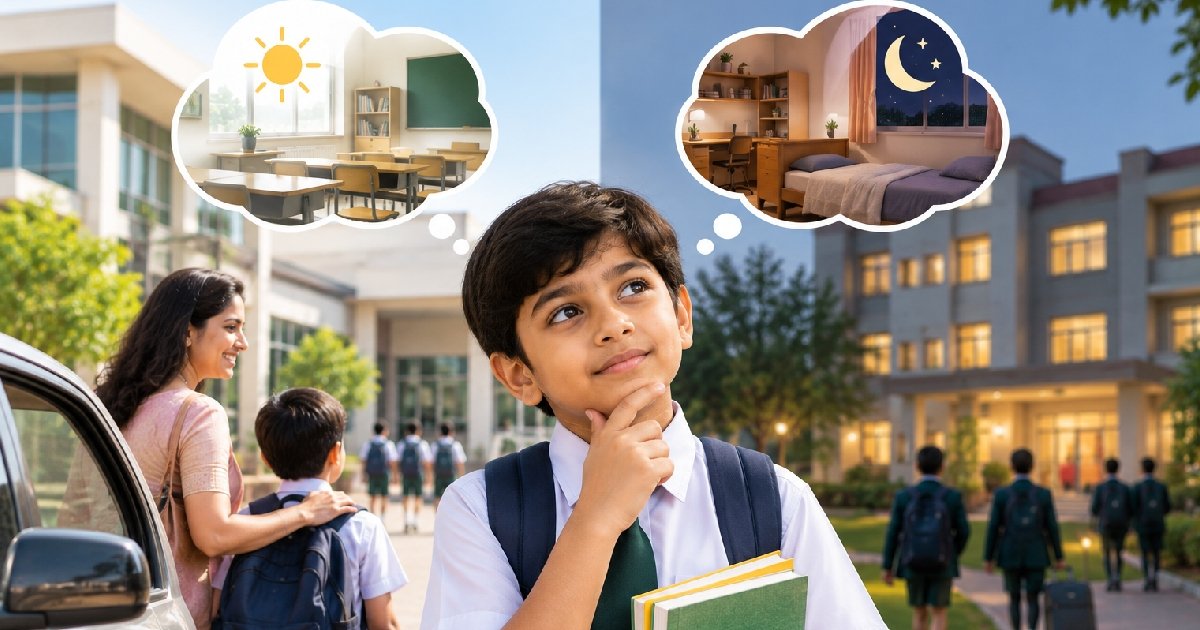
Choosing between a day school and a residential school is one of the biggest calls a Nandyal parent will make, and the evidence points both ways. A 2024 meta-analysis of 49 studies found boarding lifts cognitive and academic development while slightly lowering emotional development (Frontiers in Psychology, 2024). This guide turns that research into plain language for your child’s age and your family’s routine.
Key Takeaways
- → A meta-analysis of 49 studies (91 effect sizes) found boarding lifts cognitive and academic development (g = 0.248) but slightly lowers emotional development (g = -0.159) (Frontiers in Psychology, 2024).
- → A study of 9,324 adolescents linked boarding to higher depressive symptoms by 8th grade; school connectedness explained 24% of the effect (BMC Psychology, 2025).
- → Day schooling keeps family time daily and helps you spot problems early; boarding suits transferable jobs, senior-secondary focus, and specialist campuses.
- → There’s no universal winner. Match the model to your child’s age, temperament, and the real reason you’re considering boarding.
What’s the real difference between a day school and a residential school?
A day school teaches your child from morning to afternoon and sends them home each evening. A residential school, or boarding school, provides lodging, meals, and round-the-clock supervision on campus during term.
CBSE affiliates both models, and its affiliation bye-laws set specific norms for campuses that run hostels (CBSE). The NCPCR manual on safety and security of children in schools adds hostel and transport expectations that residential schools must follow (NCPCR, 2021). So the real difference isn’t the syllabus. It’s who holds your child’s daily routines.
Boarding isn’t one thing. Some campuses run full-term boarding, others weekly boarding with weekends at home, and most admit day scholars. Know which model you’re comparing, because a weekly boarder’s life differs from a full-term boarder’s. The table below compares both models across the factors parents ask about most.
| Factor | Day school | Residential school |
|---|---|---|
| Academics and exam focus | CBSE teaching in school hours; homework at home under your eye | Structured evening study; teachers on call after class |
| Daily supervision | Parents own meals, homework, and sleep routines | Hostel wardens supervise routines around the clock |
| Family time | Every evening and weekend with family | Weekends and holidays only, unless you pick weekly boarding |
| Independence and life skills | Builds gradually, at home pace | Grows faster through dormitory living and shared routines |
| Safety and campus life | You see your child daily; school still needs strong systems | School carries more duty of care; hostel checks become critical |
| Extracurriculars | After-school activities within commute hours | Evening on-campus activities with wider options |
What does the research say about boarding versus day school outcomes?
Pooled across decades of studies, boarding delivers no single verdict. A meta-analysis of 49 studies (91 effect sizes) found no overall effect on student development, yet that average hides two opposing moves. Cognitive and academic development improved (g = 0.248) while affective and attitudinal development slipped (g = -0.159) (Frontiers in Psychology, 2024). Net effect: sharper academics, a small emotional trade-off.
Age and setting change the picture. Urban boarders gained slightly overall while rural boarders didn’t, and younger children came out as more sensitive to separation. A residential school can look very different for a 17-year-old in board-exam year than for a young child still learning to be away from home.
Longitudinal work points the same way. One study of 9,324 seventh graders (30.3% boarders) found boarding predicted 0.28 SD higher depressive symptoms by eighth grade, with lower school connectedness explaining about 24% of the effect (BMC Psychology, 2025).
One caveat keeps this honest. Most of those boarders came from rural areas where boarding is often a necessity, so the numbers won’t map perfectly onto a private CBSE campus. They still show what to protect in any model: belonging, friendships, and regular check-ins.
When does a residential school make sense for your child?
Boarding solves real problems for some families. Parents in transferable jobs, households where both parents travel, and senior-secondary students who need long, quiet study hours all gain from campus life. Specialist residential campuses can also offer training depth that a day school can’t match.
It’s a weaker fit when the reason is vague, such as prestige or a friend’s suggestion. If your child is young, anxious about separation, or thriving at home, the academic edge rarely outweighs the emotional dip. Boarding replaces you, not just your house. No school promises to be a parent.
There’s also a middle path: weekly boarding, on campus Monday to Friday and home at weekends. If what you need is discipline and study hours, a strong day school with supervised study and built-in exam preparation solves much of the same problem without the separation.
Still weighing day versus residential? Visit the IDPS Nandyal campus and talk to the team before you decide.
What Nandyal parents weigh before choosing
For most Nandyal families the question isn’t boarding versus day in the abstract. It’s which day school, how long the commute takes, and what the school adds beyond class. Distance decides how much family time survives a school year. See our guide to reaching IDPS Nandyal for local routes and transport.
Safety and supervision come next, in either model. Judge every school by the same checklist: trained staff, transport tracking, visitor control, and clear emergency procedures. The school safety checklist for Nandyal parents runs through each check in plain language.
Curriculum continuity matters too. A CBSE day school keeps your child on a national syllabus, so a later move never restarts their education. Nandyal’s CBSE options are limited, which is exactly why our guide to CBSE schools in Nandyal lists what each school offers.
Then count the parenting hours honestly. If your child boards eleven months a year, weekends and holidays hold your entire year of daily parenting. Is that enough for your family? For many Nandyal parents it isn’t. That’s a sound reason to prefer day schooling.
A five-question self-check for your family
Before you visit a campus, sit with these five questions. They separate what you actually want from what a school assumes you want.
| Question to ask yourself | What your answer tells you |
|---|---|
| Why are we really considering boarding? | An academic gap, a job transfer, and a child’s own wish each point to a different school |
| How does our child handle nights away from home? | Children who settle at a relative’s house adapt faster; anxious children need a trial stay |
| What stage is our child at? | The emotional trade-off bites hardest in primary years; senior secondary is the common entry point |
| How often can we visit or check in? | Frequent contact and school belonging protect boarding students emotionally |
| What would a strong day school change in our week? | If commute time and study discipline are the real gaps, a day school closes them without overnight stays |
Answer on paper, not in your head. If your first two answers point at separation rather than schooling, try a short stay or an extended-hours day school. A decision this big deserves a trial, not a leap.
Day school or residential school: which is right for your child?
For a settled Nandyal family with a child in primary or middle school, a strong CBSE day school is usually the better call. The research shows boarding’s emotional trade-off lands hardest on younger children, while day schooling keeps you present every evening. IDPS Nandyal works that way, with a 15:1 student-teacher ratio and IIT-JEE and NEET foundation built into school hours.
Boarding earns its place for transferable jobs, senior-secondary focus, or a specialist campus your town doesn’t have. Pick it for a concrete reason, not because it sounds impressive, and visit first in either model. Talk to current parents and watch how staff treat children.
Both models can raise a capable, confident child. The difference is where your child feels safest while it happens. If day schooling looks right, compare options in our guide to CBSE schools in Nandyal, read our IDPS versus DPS comparison, and see why IDPS ranks among the best CBSE schools in Nandyal.
Ready to talk it through with people who know the campus? Book a visit and take your child along. One campus tour beats a hundred articles.